

Managing CX vs. Leading CX: What’s the Difference?
What is the difference between managing CX and leading CX? And what needs to change when your role evolves from managing Customer Experience to leading it?
During a CX event in Berlin, after a Think Tank session on my ANI model, a participant asked me a question that has stayed with me:
“What is actually the difference between managing CX and leading CX?”
The short answer is that managing CX is about doing a good job of managing it. Leading CX is about establishing the authority, direction, and organizational momentum needed to make the customer experience a priority throughout the business.
Neither is better than the other. Organizations need both. The scope, expectations, and way of working are different. That distinction becomes especially important when an experienced CX professional is given leadership responsibilities but continues to approach the role primarily as a CX manager.
Managing CX keeps the work moving
Managing CX means understanding the field and translating that expertise into effective execution. You run programs, improve customer journeys, work with customer insights, measure results, and ensure that initiatives move forward.
A strong CX manager is the expert people turn to. They coordinate stakeholders, secure sponsorship for initiatives, manage the CX roadmap, and keep the CX machine running.
This work is essential. Without it, ambitions remain mere ideas, and improvements do not reach customers.
Leading CX changes the scope
Leading CX requires something different from you. You don't just execute the existing strategy; you help shape it.
You set the CX goals, challenge the status quo, and link Customer Experience to business value, growth, and strategic performance.
That requires you to build a strategic network, secure executive buy-in, and ensure that CX becomes an integral part of how the organization thinks, makes decisions, and acts.
Your role shifts from being consulted when CX expertise is needed to being involved when strategic decisions are made.
The Shift from Managing CX to Leading CX
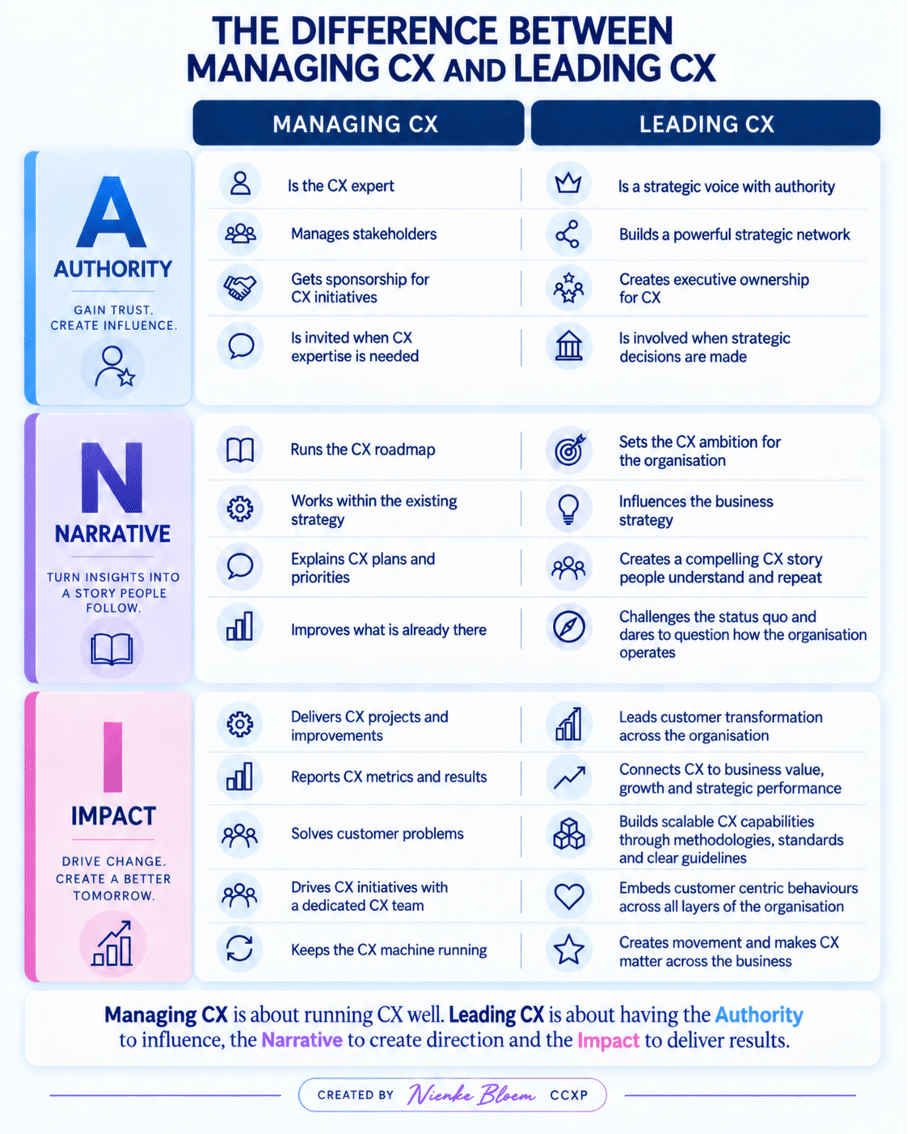
The difference becomes clearer when you look at the three elements of my ANI model: Authority, Narrative, and Impact.
Together, they illustrate where the work of managing CX ends and the broader responsibility of leading CX begins.
Authority
When managing CX, your authority often stems from being the CX expert. You manage stakeholders, secure support for initiatives, and are consulted when specialized knowledge is needed.
When leading CX, authority becomes strategic influence. You build a powerful network, secure executive buy-in, and earn a seat at the table where business decisions are made.
Narrative
When managing CX, you lead the roadmap, explain plans and priorities, and improve upon what is already in place within the existing strategy.
When leading CX, you set the direction. You define the organization’s CX vision, shape business strategy, and turn insights into a compelling story that people understand, remember, and share.
You also dare to question how the organization currently operates.
Impact
When managing CX, impact comes from delivering projects, reporting metrics, solving customer problems, and driving initiatives with a dedicated CX team.
When leading CX, your impact extends throughout the organization. You lead customer transformation, build scalable capabilities, embed customer-centric behaviors, and drive change beyond the CX team.
CX becomes an integral part of the business rather than a separate program running alongside it.
The common pitfall for experienced CX professionals
Many experienced CX professionals are given a leadership role but continue to use a management approach.
They work harder, start another project, add another dashboard, or take on more operational responsibility.
The problem is not their commitment or their expertise in customer experience. Their role has changed, but their mindset, skill set, and toolset have not kept pace with that change. The result can be increased activity without the strategic direction and organizational impact that the role requires.
Leading CX does not mean abandoning management. It means recognizing when excellent execution is no longer enough and deliberately expanding the ways in which you influence, communicate, and drive change.
In what areas do you need to grow in your role?
The line between managing CX and leading CX isn't black and white. Your role may involve both.
What matters is whether your work style still aligns with what your organization needs from you.
Use these questions to reflect on your current role:
- Where am I primarily managing CX today?
- Where am I already taking CX?
- Does my organization involve me as a CX expert or as a strategic voice?
- Where do I need more authority, a stronger narrative, or greater impact?
- What is the first change I need to make?
As your responsibilities grow, your leadership must grow along with them. That is how you move beyond simply managing the customer experience well and begin to create the conditions for the customer experience to shape the business.
Grow Your CX Leadership
Are you familiar with the CX profession, but want to build your authority, refine your narrative, and increase your impact?
The CX Leadership Masterminds helps experienced CX professionals become more effective at leading CX.
It's not about learning more CX theory. It's about becoming the leader your CX goals require.
Until next time, keep spicing up your Customer Experience leadership.
*****
Nienke Bloem is often referred to as the Customer Experience speaker in the blue dress.
She is a global CX thought leader, educator, and keynote speaker who inspires audiences with best practices and proven methodologies. She runs a speaking practice, a CX game company, and a training business; she lives and breathes Customer Experience and is the author of two books on CX.
Her two-day Customer Experience Masterclass is known as the best program to prepare for the CCXP, and she is the go-to person for CX leaders who want to advance their leadership and achieve immediate results from their Customer Experience transformation programs. Since 2020, she has been hosting a CX Leadership Masterminds program and helping leaders enhance their leadership skills and deliver an engaging CX story, including a solid CX strategy. In addition, she is a modern-day pilgrim and has drawn parallels between her journey and leading customer-centric transformations.
With over 20 years of corporate experience, she speaks the language of business. Her keynote speeches and training programs on customer experience are inspiring and practical. She is one of the few Recognized Training Partners of the CXPA, and her mission is to make customer experience work and help you achieve business results. Subscribe to her weekly CX newsletterto stay informed.