

Managing CX vs leading CX: What’s the difference?
What is the difference between managing CX and leading CX? And what needs to change when your role grows from managing Customer Experience to leading it?
During a CX event in Berlin, after a Think Tank on my ANI model, a participant asked me a question that stayed with me:
“What is actually the difference between managing CX and leading CX?”
The short answer is that managing CX is about running CX well. Leading CX is about creating the authority, direction and organisational movement needed to make Customer Experience matter across the business.
One is not better than the other. Organisations need both. The scope, expectations and way of working are different. That distinction becomes especially important when an experienced CX professional receives leadership responsibilities while continuing to approach the role mainly as a CX manager.
Managing CX keeps the work moving
Managing CX means knowing the profession and translating that expertise into solid execution. You run programmes, improve customer journeys, work with customer insights, measure results and make sure initiatives move forward.
A strong CX manager is the expert people turn to. They coordinate stakeholders, secure sponsorship for initiatives, run the CX roadmap and keep the CX machine running.
This work is essential. Without it, ambitions remain ideas and improvements do not reach customers.
Leading CX changes the scope
Leading CX asks something different from you. You do not only deliver within the existing strategy; you help shape it.
You set the CX ambition, challenge the status quo and connect Customer Experience to business value, growth and strategic performance.
That requires you to build a strategic network, create executive ownership and make sure CX becomes part of how the organisation thinks, decides and behaves.
Your role shifts from being invited when CX expertise is needed to being involved when strategic decisions are made.
The shift from managing CX to leading CX
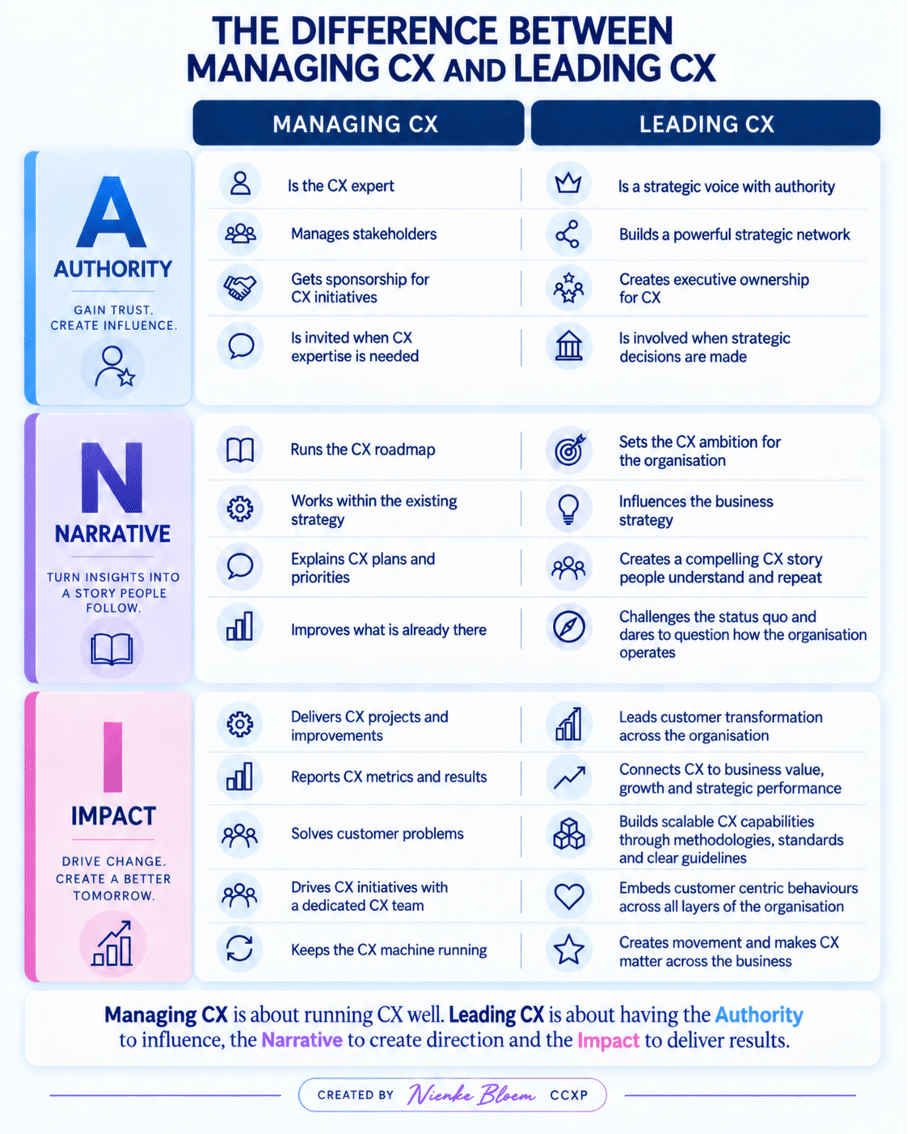
The difference becomes clearer when you look at the three elements of my ANI model: Authority, Narrative and Impact.
Together, they show where the work of managing CX ends and the broader responsibility of leading CX begins.
Authority
When managing CX, your authority often comes from being the CX expert. You manage stakeholders, gain sponsorship for initiatives and are invited when specialist knowledge is needed.
When leading CX, authority becomes strategic influence. You build a powerful network, create executive ownership and earn a place in conversations where business decisions are made.
Narrative
When managing CX, you run the roadmap, explain plans and priorities, and improve what is already there within the existing strategy.
When leading CX, you create direction. You set the organisation’s CX ambition, influence the business strategy and turn insights into a compelling story that people understand, remember and repeat.
You also dare to question how the organisation currently operates.
Impact
When managing CX, impact comes from delivering projects, reporting metrics, solving customer problems and driving initiatives with a dedicated CX team.
When leading CX, impact reaches across the organisation. You lead customer transformation, build scalable capabilities, embed customer-centric behaviours and create movement beyond the CX team.
CX becomes part of the business instead of a separate programme beside it.
The common trap for experienced CX professionals
Many experienced CX professionals receive a leadership mandate but keep using a management approach.
They work harder, start another project, add another dashboard or take on more operational responsibility.
The problem is not their commitment or CX expertise. Their role has changed, but their mindset, skillset and toolset have not changed with it. The result can be more activity without the strategic movement and organisational impact the role requires.
Leading CX does not mean abandoning management. It means recognising when excellent execution is no longer enough and deliberately expanding how you influence, communicate and create change.
Where does your role need to grow?
The line between managing CX and leading CX is not black and white. Your role may contain both.
What matters is whether your way of working still matches what your organisation needs from you.
Use these questions to reflect on your current role:
- Where am I mainly managing CX today?
- Where am I already leading CX?
- Does my organisation involve me as a CX expert or as a strategic voice?
- Where do I need more Authority, a stronger Narrative or greater Impact?
- What is the first shift I need to make?
When your responsibilities grow, your leadership needs to grow with them. That is how you move beyond running CX well and start creating the conditions for Customer Experience to shape the business.
Grow your CX leadership
Do you know the CX profession, but want to grow your Authority, sharpen your Narrative and increase your Impact?
The CX Leadership Masterminds helps experienced CX professionals become stronger at leading CX.
It is not about learning more CX theory. It is about becoming the leader your CX ambition requires.
Until next time, keep spicing up your Customer Experience leadership.
*****
Nienke Bloem is often called the Customer Experience speaker in the blue dress.
She’s a global CX thought leader, educator and a global keynote speaker who inspires audiences with best practices and proven methodologies. She leads a speaking practice, a CX game company and a training business; she breathes Customer Experiences and is author of two CX books.
Her two-day Customer Experience Masterclass is known as the best program to prepare for your CCXP and she is the go-to person voor CX leaders who want to advance their leadership and bring direct results from their Customer Experience transformation programs. Since 2020, she hosts a CX Leadership Masterminds program and helps leaders spice up their leadership and deliver an engaging CX Story including a solid CX Strategy. Besides, she is a modern-day pilgrim and found the parallel with leading customer centric transformations.
With her over 20 years corporate experience, she speaks the business language. Her keynotes and education programs in Customer Experience are inspiring and hands-on. She is one of the few Recognized Training Partners of the CXPA and it is her mission to Make Customer Experience Work and help you deliver business results. Subscribe to her weekly CX Newsletter to stay tuned.