

Your calendar is telling the truth: Time management for CX leaders
You can have a brilliant CX strategy, a beautifully designed roadmap and three crystal-clear strategic priorities. But if none of them can be found in your calendar, they are probably not going to happen.
That is the uncomfortable truth about time management for CX leaders: your calendar reveals what is really leading your agenda.
And for many CX professionals, that agenda is filled with meetings, customer complaints, stakeholder requests, emails and things that somebody needs “just quickly”.
So how do you protect time for the major projects that will actually move Customer Experience forward?
Why strategic focus is so difficult in CX
I believe the overwhelm many CX professionals experience has two causes: the nature of our profession and the nature of the CX professional.
- The nature of our profession
Everything eventually comes down to the customer. When people elsewhere in the organisation do not know what to do with a customer issue, or do not want to do the dirty work, guess where it lands? In your inbox.
Requests, projects, complaints, meetings and steering committees. Before you know it, you have become the hero of everything and your strategic focus has disappeared.
When you allow operational requests to determine your calendar, they eventually determine your CX agenda too.
- The nature of the CX professional
And then there is us. We are often friendly, helpful and service-minded. We are solution finders. We care about customers, colleagues and results.
Lovely qualities, of course. But the flip side is that we are not always brilliant at saying no. I know I am not.
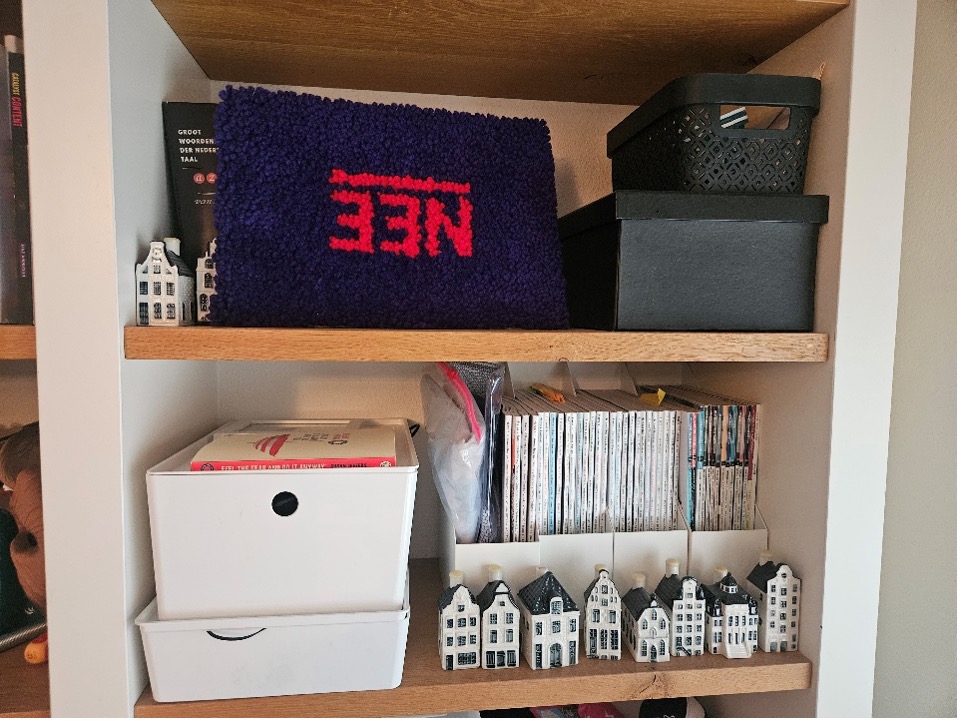
That is why my dear friend Babs gave me a piece of artwork that sits right in front of me on my desk. It says NEE, which means NO in Dutch, and it reminds me to use that word a little more often.
So we have a profession that keeps throwing things at us and a personality that keeps saying yes. That is not exactly the perfect recipe for strategic focus.
Your CX strategy also needs a time strategy
Strategising CX is about making choices. It means deciding which customer ambitions matter most, what results you want to achieve and which initiatives deserve priority.
But making those choices on paper is only the beginning.
You also need to strategise your time.
A strategic priority requires attention, energy and protected hours in your calendar. If you leave it to the gaps between meetings, emails and operational requests, those gaps will usually disappear.
A simple way to structure your priorities is the familiar story of the professor with the jar, rocks, pebbles and sand.
He fills the jar with the big rocks first, then adds the pebbles and finally pours in the sand. When you put the sand in first, there is no room left for the big rocks.
The same principle applies to your CX agenda.
You decide what goes into your jar and, most importantly, in which order.
1. The Rocks: your strategic CX priorities
Your Rocks are the major projects that need to create meaningful results. They matter to the future of Customer Experience in your organisation and they will not run themselves.
I recommend choosing three Rocks for each quarter.
Three. Not seven, nine or twelve.
Your Rocks might include:
- Developing or updating your CX strategy
- Creating a Customer Experience Strategy Map
- Redesigning an important customer journey
- Implementing a Voice of the Customer programme
- Developing an AI tooling roadmap
- Leading a customer-centric culture change
- Strengthening stakeholder commitment to CX
Look at your CX strategy, choose your three most important priorities and decide how much time you realistically need to move them forward.
Without protected time and energy, even the most important Rock will remain a good intention.
2. The Pebbles: important work that keeps things moving
Next to the big Rocks, you have the Pebbles.
These are important and often recurring activities. They keep your CX work moving, support your visibility and help you maintain relationships across the organisation.
Your Pebbles might include:
- Customer projects
- Stakeholder meetings
- Team mentoring
- Reporting and analysis
- Workshops and presentations
- Writing internal updates
- Preparing steering committee meetings
- Professional development
The Pebbles deserve space in your calendar, but they should never push the Rocks out of the jar.
That distinction matters. A task can be important without being one of your strategic priorities.
3. The Sand: everything that simply appears
And then we get to the Sand.
Emails. Calls. WhatsApp messages. An interesting post on LinkedIn. A colleague asking: “Can you just…?”
Every grain of Sand looks small. Answering one email only takes a few minutes. Joining one extra meeting does not seem like a major problem.
But together, all those small requests can fill your entire week.
Sand will always appear. The goal is not to eliminate it completely. The goal is to stop it from determining the structure of your calendar.
Turn your CX priorities into protected time
Identifying your Rocks, Pebbles and Sand is useful, but the real planning starts when you open your calendar.
I use three planning levels:
- Every quarter: define your three Rocks
Choose the three strategic priorities that deserve your attention during the coming three months.
Be specific about the result you want to achieve. “Work on CX strategy” is vague. “Create the first version of the CX Strategy Map and validate it with the leadership team” gives you something concrete to plan and complete.
- Every month: define the progress you need to make
Break each Rock down into a realistic monthly result.
What needs to be finished this month for the project to remain on track? Which stakeholders need to be involved? Which decisions need to be made?
- Every week: reserve the actual hours
This is the step that makes the difference.
Block time in your calendar for your Rocks before the week fills up with Pebbles and Sand. Treat those hours with the same seriousness as a meeting with your CEO or an important customer.
Do not simply write “work on strategy”. Define what you are going to do during that block, so you can start immediately.
Your calendar is a CX leadership tool
Your calendar is one of your most important CX leadership tools.
It shows where you focus your attention, which projects receive momentum and what you are willing to protect.
Saying that you have three strategic priorities means very little when none of them can be found in your calendar.
CX leadership is also about making choices, setting boundaries and being willing to say: this matters, this comes first and this other request will have to wait.
Use short focus blocks to get started
One final practical tip: I love working with the Pomodoro method.
I work in focused blocks of 25 minutes, followed by a five-minute break. I get a cup of tea, move around for a moment and then start the next block.
Two hours of writing becomes four manageable Pomodoros.
It sounds simple, but it helps me turn a large strategic project into work I can actually start and finish.
What does your calendar say about your CX priorities?
Take an honest look at the coming weeks.
Can you find your most important CX priorities in your calendar? Have you reserved enough time to make meaningful progress? Or has the Sand already taken over?
You are in charge of how you fill your jar.
Put the Rocks in first. Give the Pebbles the space they need. Be careful with the Sand. And dare to say no to work that is not for now.
To help you translate this into your own CX agenda, I created a one-page Rocks, Pebbles & Sand worksheet. Use it to define your three strategic Rocks, identify your Pebbles and Sand, and decide which hours you are going to protect in your calendar. You can download the Rocks, Pebbles & Sand worksheet here.
Until next time, keep spicing up your Customer Experience leadership.
*****
Nienke Bloem is often called the Customer Experience speaker in the blue dress.
She’s a global CX thought leader, educator and a global keynote speaker who inspires audiences with best practices and proven methodologies. She leads a speaking practice, a CX game company and a training business; she breathes Customer Experiences and is author of two CX books.
Her two-day Customer Experience Masterclass is known as the best program to prepare for your CCXP and she is the go-to person voor CX leaders who want to advance their leadership and bring direct results from their Customer Experience transformation programs. Since 2020, she hosts a CX Leadership Masterminds program and helps leaders spice up their leadership and deliver an engaging CX Story including a solid CX Strategy. Besides, she is a modern-day pilgrim and found the parallel with leading customer centric transformations.
With her over 20 years corporate experience, she speaks the business language. Her keynotes and education programs in Customer Experience are inspiring and hands-on. She is one of the few Recognized Training Partners of the CXPA and it is her mission to Make Customer Experience Work and help you deliver business results. Subscribe to her weekly CX Newsletter to stay tuned.